

Quick Summary: AI now handles the heavy lifting of backlink outreach, finding and qualifying prospects, drafting personalized emails, and managing follow-ups, which makes the process far faster and more consistent. What it cannot do is replace human judgment on placement quality or the real editorial relationships that produce trusted links, so the model that works is a hybrid: AI for speed and scale, people for approval and relationships.
In this article
- What AI actually does well in backlink outreach
- Where AI outreach falls short
- The hybrid model that actually works
- How to evaluate an AI outreach tool or service
- AI tool vs. agency that uses AI
- Key takeaways
- Frequently asked questions
AI backlink outreach is the use of artificial intelligence to handle parts of the link-building workflow, finding prospects, qualifying sites, drafting personalized emails, and managing follow-ups, while the final placements still depend on human review and genuine editorial relationships. AI makes outreach faster and more scalable, but it does not replace the judgment, relationships, and quality control that decide whether a link is actually worth securing, which is exactly the judgement behind manual link building. In 2026, the gap between teams that understand this and teams that “let the AI run it” has become the single biggest factor separating clean, durable link profiles from spammy ones.
This guide breaks down exactly where AI helps, where it fails, and how to tell a real outreach operation from an automated email cannon.
What AI actually does well in backlink outreach
The link-building process has always had a high-volume, repetitive layer underneath the relationship layer. That bottom layer is where AI genuinely shines.
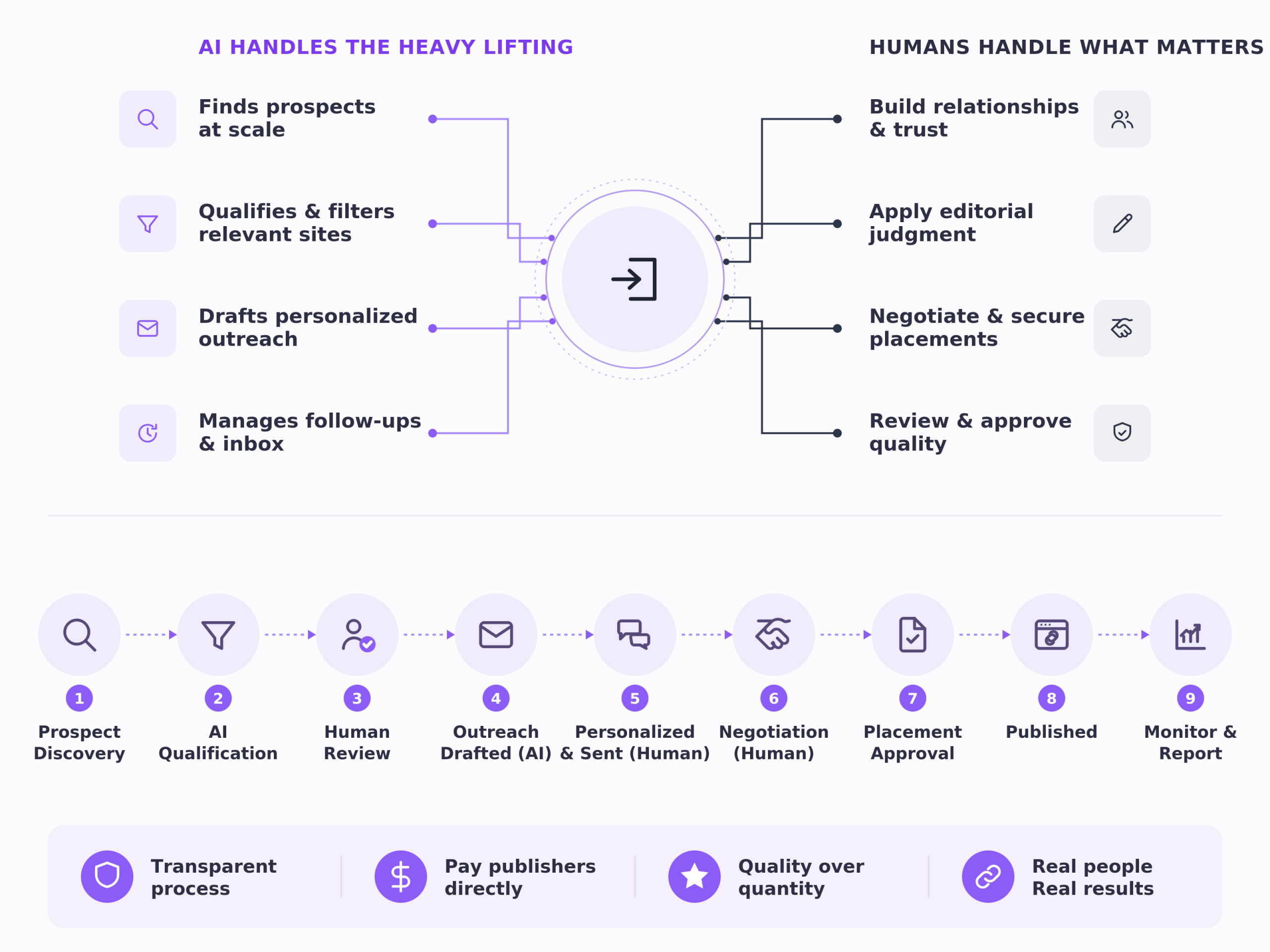
AI is strong at prospecting at scale. Instead of manually pulling competitor backlinks and combing through them, you can have AI surface thousands of candidate domains in minutes. It’s good at filtering and qualifying clustering sites by topic, flagging low-quality or irrelevant domains, and ranking prospects by authority and editorial fit before a human ever looks at the list. It can draft first-pass personalized emails by pulling context from a target site, so your team isn’t writing every message from a blank page. And it handles follow-up logistics, sequencing, reminders, and inbox management, that otherwise eat hours every week.
In short, AI removes the manual grind from the parts of outreach that don’t actually require human relationships. Done right, that frees your team to spend their time where it matters: negotiating, building rapport with editors, and protecting quality.
Where AI outreach falls short
Here’s the part most “AI outreach” pitches leave out: the things AI can’t do are exactly the things that make link building work.
AI can’t build a real relationship with an editor or site owner. Links from people who know and trust you, the ones that survive algorithm updates and actually move authority, come from human connection, not from a cold sequence. AI also struggles with true editorial judgment. It can guess at topical relevance, but it can’t reliably tell whether a placement makes genuine editorial sense or whether a site’s “traffic” is real. And AI-written outreach, when sent unedited, is now instantly recognizable. Publishers in 2026 are flooded with templated, AI-generated pitches, and their default response is to ignore or delete them. Response rates on fully automated outreach have collapsed for exactly this reason.
The deeper risk is strategic. Fully automated, volume-first outreach tends to produce low-relevance links, and at scale that’s the kind of footprint that creates risk rather than authority. The tool optimizes for “links sent and placed,” not for “links worth having.” That’s a misalignment you pay for later.
The hybrid model that actually works
The teams getting results in 2026 aren’t choosing between AI and humans, they’re sequencing them. The model looks like this:
AI surfaces and qualifies the prospect list. A human reviews and approves the shortlist before anyone is contacted. AI drafts the outreach. A human personalizes, edits, and sends it. Negotiation and relationship-building stay fully human. And every placement is reviewed and approved before it goes live, and before any cost is incurred.
This is the same principle behind a transparent, approval-based outreach process: you see the sites before they’re contacted, you approve what gets placed, and you pay site owners directly instead of through opaque markups. AI accelerates the work; it doesn’t get to make the decisions. That combination is what produces editorially relevant links at a pace that still feels human to the publishers receiving them.
How to evaluate an “AI backlink outreach” tool or service
Whether you’re comparing software or hiring a team that uses AI, the same checklist applies. Ask these questions before you commit:
Does it show you the actual sites before placement, or just promise “high-DR links”? Is there a human in the loop reviewing relevance and quality, or is the whole pipeline automated? Are you paying site owners directly and transparently, or paying markups to a black box? Does it prioritize editorial relevance over raw volume? And can it explain why each prospect was chosen, not just that it was chosen?
A good answer to all five usually means there are real people accountable for the outcome. Vague answers usually mean you’re buying volume and inheriting the risk that comes with it.
AI tool vs. agency that uses AI: what’s the difference?
This is the distinction that matters most for the decision. An AI tool gives you software and hands you the steering wheel, you still have to do the qualifying, the personalization, the negotiation, and the quality control yourself. An agency that uses AI gives you the software’s speed plus the human judgment and accountability that the software can’t provide. With a tool, you own every mistake the automation makes. With a team, someone is responsible for the result. For most brands, the question isn’t “AI or no AI”, it’s “who is accountable for quality when the AI gets it wrong?”
Key takeaways
- Use AI to scale the repetitive work: prospecting, qualifying, drafting, and follow-ups run faster and more consistently.
- Keep a human in the loop for placement quality and relationships, because that is where trust and real links are won.
- Choose a hybrid setup over a fully automated tool, since pure automation tends to produce generic outreach that publishers ignore.
- When comparing an AI tool to an agency that uses AI, judge who owns the relationships and approves each placement.
The bottom line
AI has permanently changed backlink outreach but mostly at the level of speed, not judgment. The winning approach in 2026 uses AI to do the heavy lifting of prospecting and logistics, then puts experienced humans in charge of relationships, relevance, and approval. If you’re evaluating an AI outreach tool or a team that uses one, judge it on one thing above all: whether real people remain accountable for the quality of every link.
If you’d rather have a transparent, approval-based team handle outreach, using AI for speed but keeping humans in control of quality, see how our outreach process works or request link samples.
Frequently asked questions
Yes – when AI handles workflow tasks like prospecting and drafting, and humans control relevance and quality. It becomes risky when the entire process is automated and optimized for volume, which tends to produce low-relevance links at scale.
No. Prospecting, qualifying, and first-draft emails can be automated. Relationships, editorial judgment, negotiation, and quality control cannot. Fully automated outreach is also increasingly ignored by publishers.
A tool gives you software and leaves the judgment to you. An agency that uses AI combines that speed with human review, accountability, and relationships so quality doesn’t depend on the automation being right every time.
Because publishers now recognize templated, AI-generated pitches and ignore them. Personalization by a human and genuine editorial relevance are what restore response rates.
Check whether each placement is on a relevant, real-traffic site you approved in advance, whether it makes editorial sense, and whether you can see the site before it’s contacted. If you can’t verify these, treat the links as a risk.