

Quick Summary: Real outreach logs from live campaigns show that a link has two prices, the fee you pay the publisher and the cost of all the outreach that did not convert, so the true all-in cost is always higher than a single quoted number. What you actually pay depends on niche, language and market, and format, and the metrics behind a site matter far more than its headline authority score. Use the ranges here as benchmarks, then judge each placement on relevance and real traffic.
Last updated: August 2026. Dataset: 1,225 publisher quotes and 574 completed placements collected by BacklinkOutreach.Agency across live campaigns.
In this article
- Two prices, not one
- Why declined sites still matter
- The buyer’s price ceiling
- What you are paying for
- Pricing by niche
- What a finance link costs by DR
- Pricing by language and market
- Guest post vs. link insertion
- The costs nobody quotes you
- The all-in cost of a link
- How to use these numbers when buying
- Key takeaways
- Frequently asked questions
- Packages and pricing models
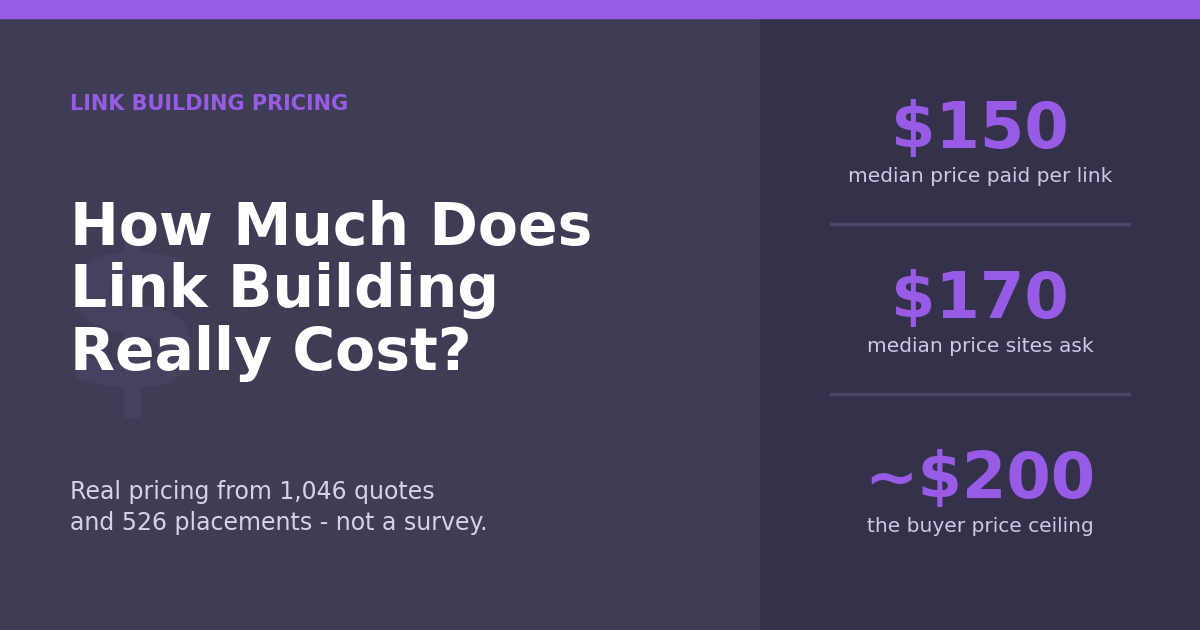
Most “link building pricing” articles run on survey data, agencies self-reporting what they charge. This one runs on something better: the real outreach logs of four live link-building campaigns, spanning Travel and Hospitality / Education and Career / Parenting and Family / Technology and Software / Marketing and Advertising / Business and Finance, and Finance and Investing. Together they cover 1,281 contacted sites, 1,225 real price quotes, and 574 placements that were secured or went live.
That distinction, quotes vs. placements, turns out to be the whole story. The price a site asks and the price a buyer pays are two different numbers, and most pricing guides only ever show you one of them. This guide shows you both.
Two prices, not one
When you ask “what does a link cost,” there are really two answers:
- The asking price, what sites quote when you reach out. The supply side of the market: every real offer, whether or not anyone took it.
- The secured price, what buyers actually committed to for the links they agreed to run. The demand side: the offers that survived a buyer’s budget and value judgment.
Here’s both, side by side, from the data:
| Asking price (1,046 quotes) | Secured price (526 placements) | |
|---|---|---|
| Median | $170 | $150 |
| Average | $269 | $179 |
| 25th percentile | $100 | $98 |
| 75th percentile | $300 | $220 |
| 90th percentile | $501 | $322 |
| Maximum | $5,000 | $1,400 |
The market asks a median of $170 and routinely floats offers into the hundreds or low thousands. Buyers secure links at a median of $150 and rarely go above $300. The gap between those two columns is the negotiating room in link building, and understanding it is the difference between paying the market’s opening number and paying a smart number.
A note on what counts as “secured.” These figures include every placement that reached agreement, not only those already live: links published, plus deals waiting on content, waiting to go live, waiting for payment, and freshly accepted new offers. All of them represent a price a buyer agreed to pay, so all of them belong in the demand-side number.
Why declined sites still matter
A critical methodological point: this analysis includes the sites buyers declined, not just the ones they bought. When a buyer passes on a site, it’s almost never because the site is bad, it’s because the price didn’t fit the budget or the perceived value at that moment. That quote is still a real market signal and belongs in any honest picture of what links cost.
And the declined sites tell a clear story: they quoted higher.
| Outcome | Sites | Median quote | Average quote |
|---|---|---|---|
| Secured (buyer agreed) | 526 | $150 | $179 |
| Declined by buyer | 481 | $205 | $354 |
| Refused by site | 18 | $291 | $616 |
Sites the buyer walked away from quoted a median of $205, roughly a third more than what got secured. The buyers here weren’t avoiding low-quality sites; they were avoiding expensive ones. Read it as a benchmark: if a placement is quoted much above ~$200 for an ordinary site, you’re in the zone where experienced buyers start saying no.
The buyer’s price ceiling
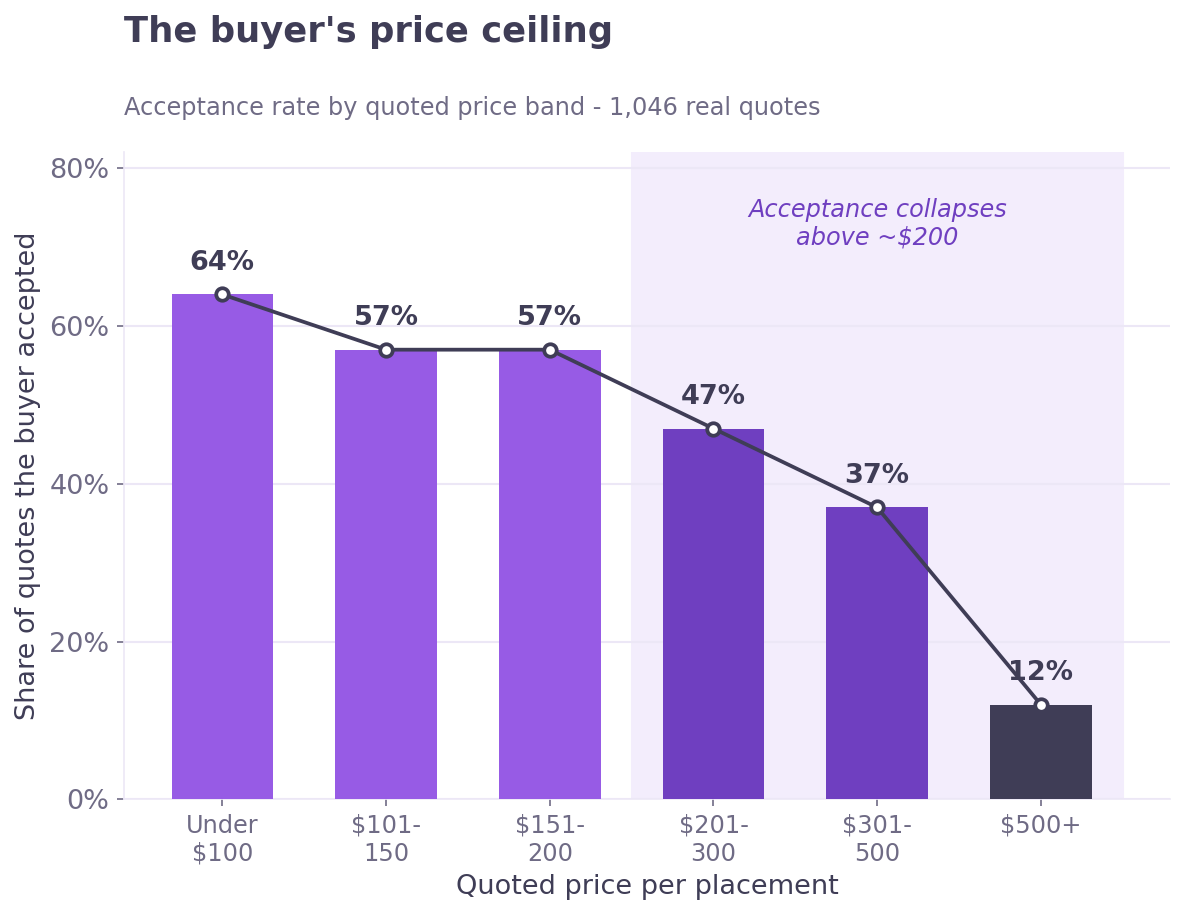
The clearest pattern in the entire dataset is how acceptance collapses as price rises. Taking every quote and asking “did the buyer go through with it?”:
| Quoted price | Acceptance rate |
|---|---|
| Under $100 | 64% |
| $101 – $150 | 57% |
| $151 – $200 | 57% |
| $201 – $300 | 47% |
| $301 – $500 | 37% |
| $500+ | 12% |
There’s a soft ceiling right around $200. Below it, the majority of quotes convert. Above it, conversion falls off steadily, and once you pass $500 it nearly vanishes. This is the practical budget tolerance of real buyers: most are willing to pay up to roughly $200 for a standard link and treat anything beyond that as a special case that needs strong justification.
What you’re paying for: authority is only the starting point
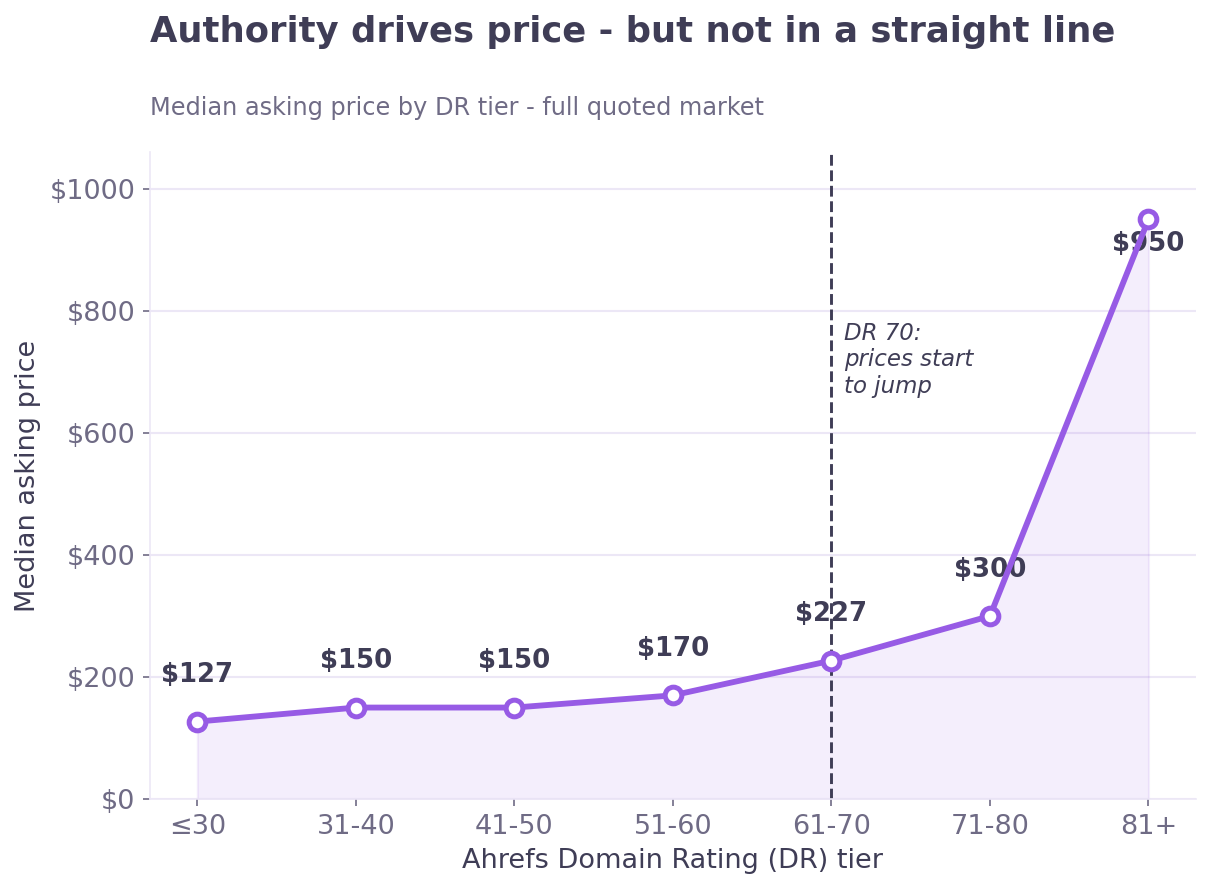
Prices do track the publishing site’s authority. Here’s the asking market, every quote, by Ahrefs Domain Rating (DR):
| Domain Rating | Quotes | Median ask | Average ask |
|---|---|---|---|
| DR ≤ 30 | 165 | $127 | $184 |
| DR 31–40 | 204 | $150 | $174 |
| DR 41–50 | 202 | $150 | $184 |
| DR 51–60 | 172 | $170 | $251 |
| DR 61–70 | 146 | $227 | $339 |
| DR 71–80 | 132 | $300 | $437 |
| DR 81+ | 17 | $950 | $1,389 |
The chart above covers the three general-niche campaigns only. Finance is measured separately and charted further down.
The curve is gentle up to DR 60, then steepens sharply. DR 70 is the inflection point, below it you’re mostly in two-figure-to-$200 territory; above it, prices climb into the hundreds, and the rare DR 81+ site asks a median of $950. Those top-tier quotes (DR 85+ sites asking $2,000–$5,000) are real, not data errors, but note how few buyers paid them. Most DR 81+ asks were declined, which is exactly why the secured prices for that tier ran far lower.
Don’t buy DR, buy the metrics behind it
Here’s the trap: a high DR is one of the weakest signals of whether a placement is actually worth the money. Plenty of DR 60–70 sites are guest-post farms, they publish dozens of articles a day across every niche, link out to casinos, crypto, and payday loans, and inflate their authority by selling links rather than securing them on merit. You can overpay handsomely for one of those.
Traffic is a better signal than DR, but even traffic volume can mislead. A detailed framework published by an outreach agency on how to evaluate whether a website is worth outreach makes the case well, and its evaluation checklist is worth pricing into your decision. The signals that matter beyond DR:
- Traffic quality, not size. A site with 200,000 visits from random trending or branded keywords is often weaker than a focused publication with 15,000 highly relevant ones. Look at branded vs. non-branded split, keyword intent, topical consistency, and whether the traffic trend is stable or a temporary spike.
- Traffic geography. A site whose audience is mostly in one region delivers little for a brand targeting another. Audience geography should align with your business geography.
- Outbound link behavior. Compare referring domains to linked domains. A site that links out to far more domains than link back to it is usually selling placements as its primary business, a red flag for long-term value.
- Topical relevance as audience overlap, not just “same industry.” The real question is whether the publication would naturally reference your topic in an editorial context.
- Editorial and indexation health. Real authors, a genuine editorial process, content written for readers rather than for indexing, and pages that actually stay in Google’s index. Mass-produced AI content and patchy indexation are warning signs.
- AI-citation visibility. Whether the site gets cited in AI Overviews is becoming a meaningful authority signal.
The practical takeaway for budgeting: two sites at the same DR and the same price can be worth wildly different amounts. The price you should be willing to pay depends on these qualitative signals far more than on the authority score a vendor puts in front of you. Paying $200 for a clean, relevant, well-indexed publication is a good deal; paying $200 for a DR-inflated link farm is a waste, no matter how strong the number looks.
Pricing by niche (vertical)
A note on method: the per-row “niche” field in raw outreach logs is mostly blank and unreliable, so niche here is read from each campaign’s vertical, the topical neighborhood the donor sites were sourced from:
| Vertical | Asking median | Secured median | Quotes |
|---|---|---|---|
| Finance and investing (stocks, trading, brokerage) | $350 | $318 | 179 |
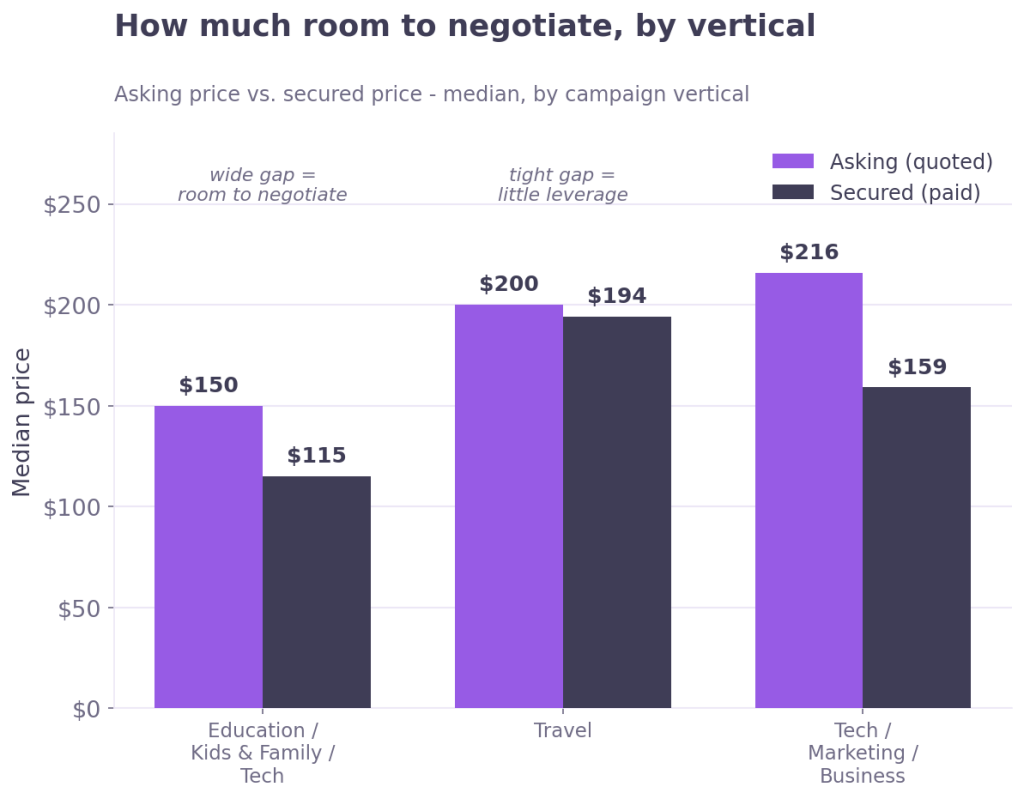
| Technology and Software / Marketing and Advertising / Business and Finance | $216 | $159 | 286 |
| Travel and Hospitality | $200 | $194 | 113 |
| Education and Career/ Parenting and Family / Technology and Software | $150 | $115 | 644 |
Finance aside, tech, marketing and business sites command the highest asks: those publishers know their commercial audience is valuable. Travel is the standout: its asking and secured prices sit close together ($200 vs. $194), meaning travel buyers paid much nearer the asking price, with little room to negotiate down, a sign of tighter supply in that vertical. Education and family sites were the most affordable and had the deepest supply, with buyers routinely negotiating a $150 ask down to roughly $115.
Finance is the outlier, though not by the margin the industry usually claims. Across 179 vetted finance donors covering stocks, trading, investing and brokerage, the asking median was $350 and the median actually paid was $318. That is roughly double the education and family figure, but nowhere near the 3–10× premium routinely quoted for “restricted” niches. The more telling number is the gap between asking and paid: about 9% in finance, against 23% in education and family. In a vertical where a single placement can be worth thousands in customer lifetime value, publishers know it, and they hold their price.
What publishers ask versus what buyers actually pay
Median publisher fee per placement, by vertical. USD.
The gap between asking and paid runs about 9% in finance, against 23% in education and family: finance publishers hold their price.
What a finance link costs by DR
Authority drives the finance premium, but not smoothly. Price is close to flat from DR 15 to DR 69, then steps up sharply above DR 70. The donors in this set span DR 15 to DR 92; bands are drawn on the range actually observed rather than on a notional 0–100 scale.
| DR band | Asking median | Middle 50% of quotes | Quotes |
|---|---|---|---|
| DR 15–29 | $300 | $200–$500 | 12 |
| DR 30–49 | $243 | $130–$350 | 40 |
| DR 50–69 | $300 | $150–$461 | 55 |
| DR 70+ | $500 | $336–$850 | 70 |
Asking price for a finance placement, by DR band
Dot is the median; the bar spans the middle 50% of quotes. 179 vetted finance donors, USD.
Price is effectively flat from DR 15 to DR 69, then doubles above DR 70. No donor in this set sits below DR 15 or above DR 92.
Two things stand out. There is no meaningful price difference between a DR 35 site and a DR 65 site: both cluster around $250–$300, and the DR 30–49 band is actually the cheapest in the set. Paying a premium to move from DR 40 to DR 60 in finance buys you a number, not a rate. The real step change comes at DR 70, where the median doubles to $500 and the top quartile reaches $850.
One caveat on scope. Every figure in this section is the publisher’s fee for the placement itself. It does not include content, prospecting, outreach, or the failure rate behind each live link. Those costs are broken out further down.
What that means in practice: the $318 median is a floor, not a budget. Add content at roughly $50 a piece and a finance placement starts near $370 before anyone has spent an hour on outreach. Above DR 70, where the placement fee alone runs $500, the same arithmetic starts at $550.
One caveat on what is still missing. Casino, crypto, CBD and adult remain outside this dataset, and those verticals do run several times the figures above. Finance sat on that list here too, until we measured it, which is a reasonable warning about how much of the “3–10× for restricted niches” rule of thumb is folklore rather than data. The same is true of legal: publisher fees in link building for lawyers sit well above these medians, because the clicks behind those pages are worth more.
Pricing by language and market
English dominates the supply but is far from the most expensive. The asking market by language:
| Language | Median ask | Average ask |
|---|---|---|
| English | $190 | $262 |
| French | $240 | $351 |
| Spanish | $313 | $359 |
| Italian | $275 | $416 |
| German | $378 | $648 |
English is the deepest, most competitive market, which keeps its median moderate despite huge volume. Every non-English market carries a thin-supply premium, and German sits at the top. German placements were the most expensive per-site in the dataset, with individual asks reaching $600+ and an average near $650. The German sample is small, so treat the exact figure as directional, but the direction is unambiguous: German link building is a premium, low-supply market, and you should budget several times the English rate for it. The same logic applies to other thin-supply languages.
Guest post vs. link insertion
Two formats, near-identical pricing:
| Format | Secured median |
|---|---|
| Guest article (new post) | $150 |
| Link insertion / niche edit | $175 |
The link insertion (niche edit) carried a slight premium, counter to the common belief that niche edits are cheaper. An existing, indexed page already has age, traffic, and ranking signals, so the link can carry value immediately rather than waiting for a fresh post to gain traction. You’re paying for the page’s existing equity.
If you want these placements done for you, in existing indexed articles with every site vetted first, see our niche edit pricing and process.
The costs nobody quotes you
The placement fee is the visible price. The true cost of a link is higher once you add everything around it.
1. You usually write the content yourself
In 96% of these placements, the buyer supplied the article, the site just published it. So your real per-link cost is the placement fee plus content:
| Content approach | Added cost per link |
|---|---|
| AI-assisted + light edit | $20 – $50 |
| Freelance writer (general) | $50 – $120 |
| Specialist / native writer | $150 – $300 |
A “$150 link” is often really a $200–$350 all-in link once the article is accounted for. In non-English markets, native-writer costs push this higher still.
2. Outreach has a failure tax
Across the three campaigns, 1,091 sites were contacted and roughly half resulted in a secured placement. But that’s the logged, already-engaged funnel, the raw cold-email top-of-funnel is far wider, with industry reply rates typically in the 5–15% range. And as the evaluation framework above shows, a large share of any raw prospect list (often 40–80%) is unusable junk that should be filtered out before a single email goes out. Every secured link is subsidized by the dozens of dead ends and rejected prospects behind it. That qualification-and-outreach labor is the single biggest reason agencies charge well above the raw placement fee, they’re pricing in the misses and the filtering.
3. Tools and overhead
Every price in this analysis was filtered on authority and traffic data, which means an Ahrefs/Semrush subscription, plus email-finding and outreach software, plus site-classification tooling: realistically $100–$500+/month. Spread across a campaign it adds a few dollars per link, but it isn’t zero.
4. Disclosure and risk
A striking finding: where disclosure was logged, 98% of links went live with no “sponsored” or paid-partnership label. This is standard in the paid-link economy, and it runs directly against Google’s guidelines, which require paid links to be marked rel="sponsored" or nofollow. That’s not an endorsement; it’s a description of how the market actually operates, and a risk you’re implicitly buying into. Price that risk into your decision.
The all-in cost of link building, per link
Pulling it together. Note what this section answers and what it does not: the numbers below are the cost per link, meaning the all-in cost of link building divided by the links that actually go live. That is a different question from what you should budget per month, and a very different one from the cost per backlink a marketplace advertises, which excludes every hour of work behind it.
| Sourcing model | Realistic all-in cost per link |
|---|---|
| DIY (your outreach + content) | $150 placement + ~$50 content + your time + tools ≈ $200–$250 + labor |
| Freelance link builder | $150 – $350 per link |
| Mid-market agency | $250 – $600 per link, all-in |
| Premium / restricted niche (casino, crypto, CBD) | $500 – $3,000+ per link |
| Finance and investing (measured, this dataset) | $370 – $900 per link, all-in |
| German / thin-supply languages | add a 2–4× premium over English rates |
The gap between the $150 placement fee and a $250–$600 agency price isn’t pure markup. It’s the work our outreach link building service does: the content, the prospect qualification, the outreach labor, the failure tax, and the tools, bundled into one invoice.
Link building packages and pricing models
Most link building pricing you will see online comes packaged, and the package format itself tells you a lot. Per-link bundles (“5 links, DR 50+, $500”) only work economically when the vendor controls the inventory, which is why packages priced below the publisher medians above almost always mean networks. If a package price per link is lower than what real publishers charge, someone is not being paid, and it is usually the publisher.
Monthly link building packages from agencies are a different animal: you are buying capacity and process rather than a fixed link count. The honest versions price the work and pass publisher fees through at cost; the less honest versions blend everything into one number where the markup lives. Our own model is the first kind: hourly plans from $1,250 to $2,600 per month for the outreach work, with every publisher fee quoted to you separately before you approve the placement. The mechanics are described on our outreach link building service page.
Whichever model you buy, apply the same test: ask the vendor to split any quoted price into work and publisher fee. A vendor who can answer has a process; a vendor who cannot has a spreadsheet of inventory.
How to use these numbers when buying
- Anchor to $150, negotiate from the ask. Sites open around a $170 median; buyers land around $150. The space between is yours to negotiate.
- Respect the $200 ceiling. Above ~$200, even experienced buyers decline most offers. Pay it only when the site’s quality clearly justifies it.
- Don’t buy DR, buy the signals behind it. Traffic quality, audience geography, outbound-link behavior, topical relevance, editorial and indexation health, and AI-citation visibility tell you what a placement is actually worth. A high DR with weak fundamentals is overpriced at any number.
- Declined ≠ bad. A site you passed on for price may be perfectly good. The reason to walk is the number, not the quality, so counter-offer rather than crossing it off.
- Budget for content and misses. Realistic per-link cost is the placement fee plus 50–100% for content and overhead.
- Know your vertical and language. Travel runs near its asking price; education is the cheapest and deepest; German and other thin-supply languages carry steep premiums; restricted niches play by entirely different rules.
Key takeaways
- Budget for the all-in cost, not just the publisher fee: failed outreach and content production add real expense per live link.
- Ignore headline authority scores in isolation and check the traffic and relevance behind them before you pay.
- Expect prices to swing with niche, language, and format, so compare quotes against the right benchmark for your market.
- Treat published ranges as a sanity check, then negotiate and evaluate each placement on its actual value.
Methodology and limitations
Based on the full outreach logs of four real campaigns, one in Travel and Hospitality, one in Education and Career / Parenting and Family / Technology and Software, and one in Technology and Software / Marketing and Advertisement / Business and Finance, covering 1,281 contacted sites, 1,225 quoted prices, and 574 secured placements. “Secured” includes links already live plus deals agreed and awaiting content, go-live, payment, or invoicing. Crucially, the analysis also includes sites the buyer declined, because a quote is a real market price regardless of whether anyone paid it. Prices were normalized to USD at recent rates (GBP, EUR, AUD, IDR converted). Niche is read at the campaign-vertical level because per-row niche tags were sparse and unreliable.
The finance figures come from a separate, hand-vetted donor list of 190 sites built for stocks, trading and investing campaigns, of which 179 carried a quoted price and 48 became paid placements. Domain Ratings in the set run from 15 to 92. Quotes in GBP, EUR and AUD were converted to US dollars at the rates in effect on 7 August 2026 ($1.3458, $1.1530 and $0.7035 respectively), and rows with no currency marked were treated as US dollars. Sites the client declined are included in the asking-price figures, since a quote is a quote whether or not it was accepted. One outlier, a $50,000 quote from a top-tier national business newspaper, was excluded as unrepresentative of the market these numbers describe.
If you are still weighing whether to pay for placements at all, our guide to buying backlinks breaks down what the money actually buys and where the risk concentrates.
Honest caveats:
- Three campaigns in mainstream verticals, a meaningful sample, not a market census. Restricted/premium niches cost far more and aren’t represented.
- The roughly 50% hit rate reflects logged, engaged contacts, not raw cold-email volume.
- The German and other non-English figures rest on small samples, directionally reliable (clear premium), but not precise.
- Self-reported metrics and one-off negotiated prices introduce normal noise; individual placements deviate from the medians in both directions.
What this data gives you that surveys can’t: actual quoted and secured prices, tied to the real authority, traffic, vertical, and language of the sites involved, plus the conversion economics connecting the two. The bottom line for a mainstream, mid-tier link: sites ask a median of ~$170, buyers secure links at a median of ~$150, and the all-in cost once you add content and overhead lands around $200–$350.
Frequently asked questions
There is no single number. The publisher fee is only part of it, and the all-in cost also includes content and the outreach that did not convert. Real ranges vary widely by niche, market, and format, so treat any single figure as a rough benchmark.
Price depends on the site’s real traffic and relevance, your niche, the language and market, and whether it is a guest post or a link insertion. Two links with the same authority score can cost very different amounts for good reasons.
Not on its own. Authority scores are easy to inflate, so it is smarter to check the traffic and topical relevance behind the number before paying a premium for a big DR.
It is the publisher fee plus content production plus the share of outreach that never converts, spread across the links you actually win. That is why the true cost per live link is always higher than a quoted price.
Per-link packages on marketplaces typically run $80 to $300 per link, but our data shows real publishers ask a median of $170 per placement before any work is paid for. Packages priced below that line are usually built on inventory the vendor controls. Agency monthly packages price capacity instead: with us that is $1,250 to $2,600 per month for the outreach work, plus publisher fees passed through at cost.
Across 526 completed placements, the median secured price was $150, with most links landing between $98 and $220 before content and agency work. Higher DR, competitive niches, and non-English markets push that up. A fair quote splits cleanly into work and publisher fee; a quote that cannot be split is hiding something.
Across 179 vetted finance donors, the median asking price was $350 and the median actually paid was $318 for the placement itself. Below DR 70 most quotes cluster between $200 and $500. Above DR 70 the median doubles to $500, with the upper quartile at $850. Once content and outreach are added, a realistic all-in cost runs $370 to $900 per link.
Agencies that resell link building can apply the same cost logic through our white label link building: hourly work plus publisher fees at cost, with your own client pricing on top.